In recent days, the University of Milano-Bicocca has further strengthened its international presence through an institutional and scientific mission to China by Professor Giuseppe Citerio, Full Professor of Anesthesiology and Intensive Care. The activities were primarily based in Changsha, at Xiangya Hospital and its affiliated institutions.
Xiangya Hospital is the main clinical and academic hub of the Xiangya School of Medicine, affiliated with Central South University, one of China’s most prestigious universities. The hospital is a leading center for medical education, research, and high-complexity clinical care, particularly in intensive care medicine and clinical neurosciences.
The mission marked Professor Citerio’s fourth visit to Xiangya Hospital, where he serves as a guest lecturer in the Department of Intensive Care Medicine. The program combined educational and clinical activities, including hybrid-format lectures, structured discussions of complex clinical cases, multidisciplinary exchanges, and bedside teaching.
On 12 January, Professor Citerio delivered an online lecture to more than 1,500 Chinese intensivists, dedicated to the management of severe traumatic brain injury. The lecture addressed key topics such as optimization of emergency care pathways, monitoring of fundamental neurological parameters, personalization of therapeutic strategies, and prevention of complications.
A central component of the mission was the Neurocritical Care Elite Winter Camp – International Training Program, held from 13 to 18 January. Promoted by Xiangya Hospital together with national Chinese health and scientific institutions, the program involved 79 physicians from hospitals across the country. Conceived as an international extension of the Neurocritical Care Summer School developed at the University of Milano-Bicocca, the Winter Camp adopted a training model based on the integration of pathophysiology, advanced clinical practice, and structured case discussions.
During the Winter Camp, Professor Citerio delivered keynote lectures on severe traumatic brain injury, advanced neurological monitoring, and the management of neurological complications. He also took part in ward-based clinical activities and complex case discussions. The close interaction with local professionals fostered in-depth exchanges on organizational models, clinical decision-making, and multiprofessional integration in neurocritical care.
Another key outcome of the mission was Professor Citerio’s contribution to two major national Chinese Expert Consensus documents. He participated in the final drafting meeting of the Consensus on the clinical application of quantitative electroencephalography (qEEG) in critically ill patients, working alongside experts in intensive care, neurology, and neurosurgery to define clinical indications, operational standards, and interpretative criteria for qEEG use in clinical practice.
In addition, the process for developing a second Consensus focused on temperature management in critically ill patients was initiated, with the aim of providing evidence-based recommendations for targeted temperature management in neurocritical care.
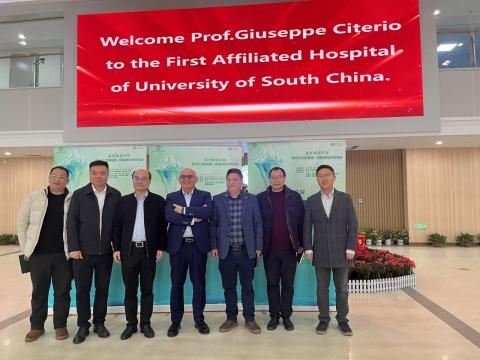
As part of the mission, institutional visits were also conducted at the First Affiliated Hospital of the University of South China (Nanhua Hospital) in Hengyang and at the Nanning First People’s Hospital, opening exploratory discussions on potential clinical, educational, and research collaborations.
These activities form part of the broader strategic internationalization pathway of the University of Milano-Bicocca, reinforcing its role as a leading academic and scientific hub in the global landscape of critical care medicine and promoting the University’s educational model in high-complexity international settings.


